Your dog comes home from an hour of fetch still bouncing off the walls. Then one slow walk around the block, where he stopped to smell every mailbox, every patch of grass, every fire hydrant, and he’s asleep on the rug before you get your shoes off.
That’s not a coincidence. Smelling is work for a dog, and it’s the kind of work that actually tires him out.
Sniffing is brain work, not dawdling
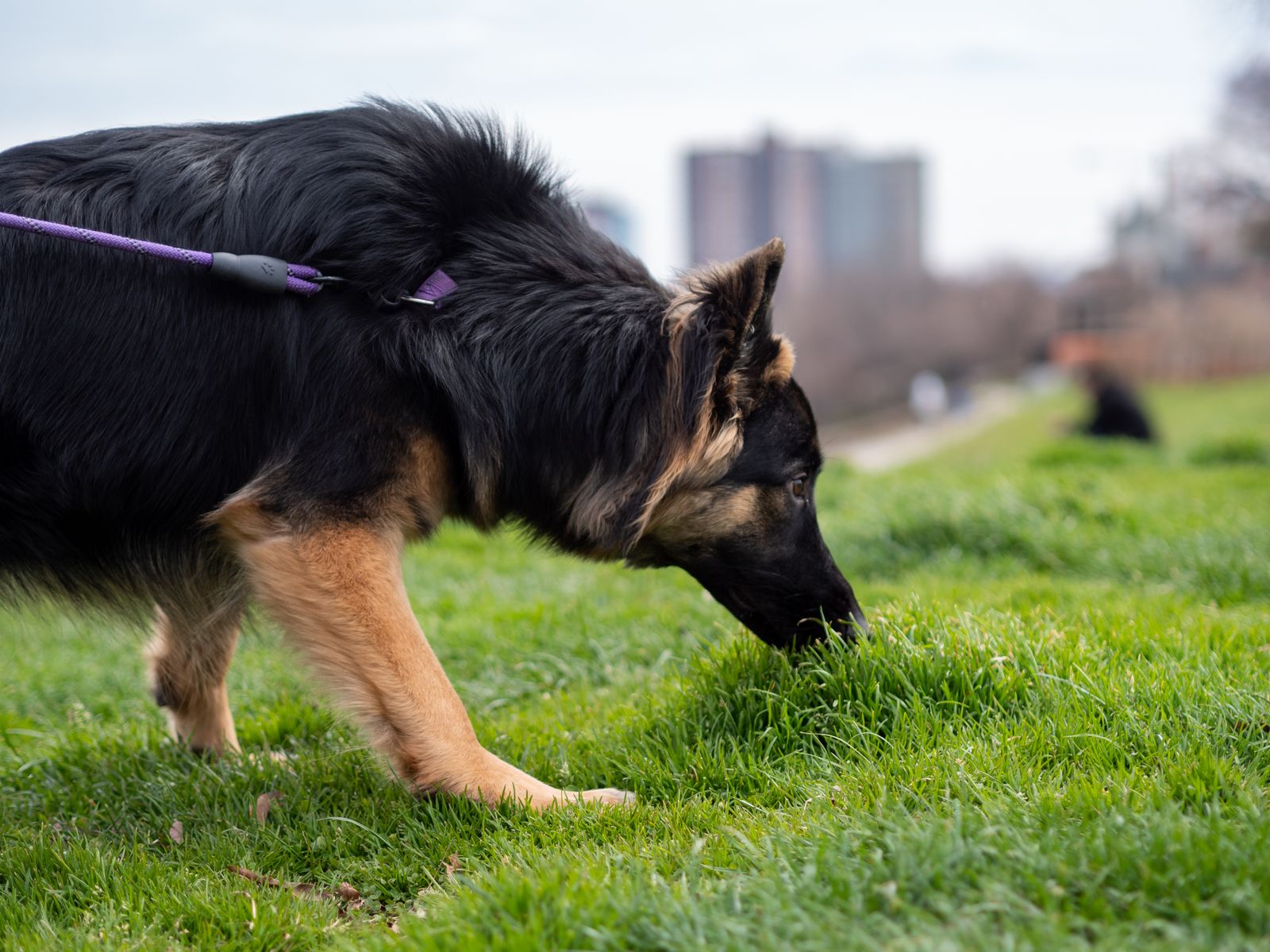
A dog’s nose is not a nicer version of yours. It’s a different instrument. Dogs carry around 300 million scent receptors. You carry about six million. A big share of a dog’s brain is wired to process what that nose brings in. When your dog stops to smell a lamppost, he’s not wasting time. He’s reading the neighborhood news, and his brain is doing the reading.
Physical exercise tires the body. Sniffing tires the brain. And a tired brain is what settles a dog down. Trainers have said it for years: ten minutes of nose work can take more out of a dog than thirty minutes of running. The dog who spent the morning solving smells comes home calm. The dog who only ran comes home fit — and still restless.
Learning to read your dog goes beyond the walk, too. If you’ve ever wondered why your dog stares at you, that look is another message worth learning to read.
What a sniff walk actually is
It’s a normal walk with one rule change: the dog sets the pace, and the nose sets the route.
Let him stop. Let him go back to the same bush three times. Let him take the long way around a smell that interests him. Keep the leash loose enough that he can actually reach the things he’s smelling — a short, tight leash turns a sniff walk into a tug-of-war, and the whole point is gone.
Ten minutes is enough. You don’t need a park or a trail. The block you already walk has more smell in it than you think. Every dog that passed through left something behind, and your dog can read all of it.
What not to do
Don’t drag him past the good smells because you’re in a hurry. That’s the walk. The smelling IS the walk.
Don’t treat it as wasted time, either. The point of a walk was never just the steps. If your dog comes home calmer after a slow, sniffy loop than after a fast march, that tells you what he needed. Believe him.
And don’t worry that you’re spoiling him. Letting a dog use his nose is not indulgence. It’s the thing his brain was built to do.
Try it tomorrow
Take the usual route and give him ten minutes to run it his way. No agenda, no pace, no pulling him along. Just you, a loose leash, and a dog doing the one thing he’s better at than any creature you know.
Then watch what happens when you get home.
FAQ
Will a sniff walk make my dog pull more?
No. The opposite, usually. A lot of pulling comes from a dog who never gets to stop and check things out. Give him the sniffing time and the pulling often drops on its own.
Is ten minutes really enough?
For most dogs, yes, as a daily add-on. It’s not a replacement for real exercise. It’s the mental half of the walk that most walks skip.
What if my dog sniffs everything and never moves?
That’s a dog doing his job. Give him the time. If you’re on a schedule, do the sniff walk as a separate short loop, five minutes out and five back, and keep your brisk walk for the rest.