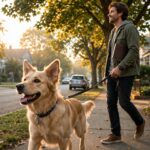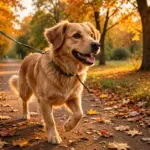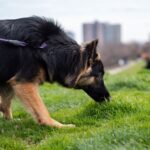
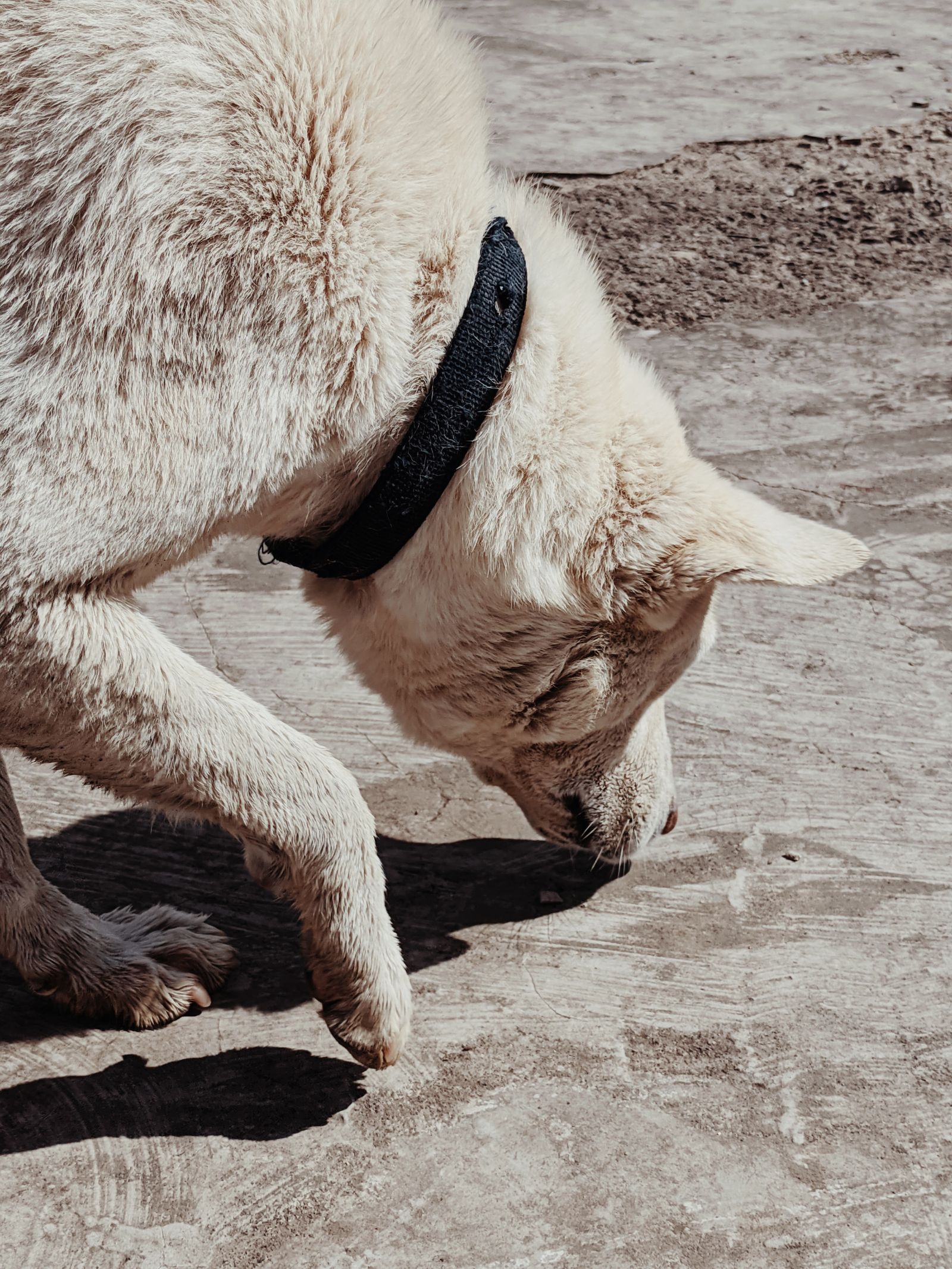
Writers are told to sit at the desk and think. The dog has a better idea. Go outside, put your nose down, and pay attention. A sniff walk is not exercise. It is research. Your dog has been doing fieldwork twice a day for years, and you have been dragging him past the good stuff.
What is a sniff walk?
A sniff walk is a walk where the dog sets the pace and the route. He stops. He sniffs. He reads the news on every tree, every gate, every patch of grass. You do not hurry him along. You wait. That is the whole method, and it is harder than it sounds, because waiting is not what humans do on walks. Humans walk to get somewhere. Dogs walk to find out what happened here.
The walk is slow. The walk is the point. A dog that is allowed to sniff is a dog that is telling you what matters on this street: who passed by, what changed, where the cat slept. That is information, and information is what ideas are made of.
Where do the ideas come from?
They come from the ground, at nose height, where you never look. The wall where the cat sits every morning at eight, watching the street like it owns it. The gate your dog has to check, every single day, in case something changed behind it. The puddle he claimed in October and still defends in November. None of this is planned. All of it is plot. A character with a routine, a place with a secret, a question with no answer yet. That is a scene, and your dog found it before breakfast.
Your dog does the noticing for you. He stops, and you stop, and for three seconds you are both looking at the same thing. That shared attention is a scene. It has a setting, a character, and a question: what happens next? Your dog has a story, and it is worth writing down before you forget it.
What do you do with it?
Leave the phone in your pocket. Bring a notebook, or just remember one thing. One thing per walk. The gate. The cat. The smell of rain on a street that never had rain before. One true detail a day is a notebook full of scenes by Christmas.
Most walks will give you nothing. That is fine. You are not walking for the boring days. You are walking so the good day does not slip past. The day the dog found the hole in the fence is a story. The day he walked past it is not. The walk tells you which day it was.
Where does the idea go?
That is the part that is changing right now. The screenplay tool is live now, and it is the movie version of your walk: a full rough draft from your idea. Take, blueprint, draft. Ninety to 110 pages, built with you. The gate, the cat, the puddle, they become a script, and you become the writer who finishes it.
The tool was built by a screenwriter, Matt Allen, Writers Guild member since 2001, with credits on Four Christmases, Soul Surfer, and Nine Lives, and co-created with Steve Smythe, who built the software system. The brain does the storytelling. The AI does the typing. You do the writing that only you can do.
What does it cost?
One pass is $97, or $48.50 with the code WRITE101. Launch pricing — half price while the launch offer runs. One time. No subscription. One idea in, one rough draft out. Start with the screenplay.
FAQ
Do I need a special kind of dog?
No. Any dog that stops to sniff will do. The sniffing is the method, not the breed.
How long should a sniff walk be?
Ten minutes is enough. The dog sets the pace. A short walk where he actually sniffs beats an hour of marching past everything.
What does the screenplay pass cost?
$97 for a one-time pass, or $48.50 with the code WRITE101. No subscription.
ABOUT AI GLOBAL ENTERTAINMENT
AI Global Entertainment makes films and builds tools for storytellers, and runs the Buzz Daily family of publications.