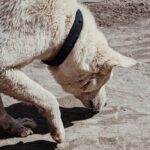

The blank page wins every morning you sit down and stare at it. It does not argue. It just sits there, white and patient, while the idea you had in the shower evaporates. The dog has a better plan. He is at the door with the leash in his mouth. He wants out, and the walk is where the block breaks.
What is writer’s block, really?
It is not a lack of ideas. It is a pile of them with no way in. You have the dog, the walk, the gate, the neighbor with the loud truck, the time he stole the sandwich off the counter and ran. You have all of it. What you do not have is a first sentence that feels safe enough to write down.
So you wait for the perfect opening line, and the page stays blank, and the dog waits by the door. The block is not emptiness. It is pressure, the feeling that the first line has to be good. The dog does not have that problem. He just starts walking.
Why does the walk work?
Because walking gives your brain a job that is not writing. Your feet move, your eyes move, and the part of your mind that was guarding the blank page loosens its grip. The gate your dog checks every day. The smell on the corner that stops him cold. The cat on the wall, watching. These are not distractions. They are material, and your brain starts sorting them into scenes without asking permission.
Ask any writer where the idea arrived and the answer is rarely the desk. It is the shower, the drive, the walk. The walk is the best of the three because the dog is doing the noticing for you. He stops, you stop, and for a few seconds you are both looking at the same small thing. That is a scene. It has a place, a character, and a question. What happens next?
What is the Take, the Blueprint, and the Draft?
That is the path through the block, and it is how Rough Draft Maker works. It starts with the Take: your idea, in your words. The dog, the walk, the stolen sandwich, whatever you have. Then the Blueprint maps every scene, so you can see the whole story before you write a page of it. Then the Draft: a full rough draft, 90 to 110 pages, built with you, scene by scene.
The tool was built by Matt Allen, a Writers Guild screenwriter since 2001 who co-wrote Four Christmases and Soul Surfer. The storytelling brain inside it is his craft, 25-plus years of it, 13 editorial points and 32 governing rules, paired with a software system built by Steve Smythe. It is not a chatbot. It is a screenwriter’s method, turned into a tool. More than twenty working WGA screenwriters have put it through its paces.
You bring the idea. The tool helps you shape it into a blueprint, then a draft. The block never gets a vote, because you are never staring at a blank page. You are always working from the next scene on the map.
What does it cost?
One pass is $97, or $48.50 with the code WRITE101. Launch pricing — half price while the launch offer runs. One time. No subscription. One idea in, one rough draft out. Start your screenplay.
FAQ
I have never written anything. Can I still do this?
Yes. You need an idea, and a dog story is a fine one. The tool walks you through the Take, the Blueprint, and the Draft, one step at a time.
What if my idea is just my dog?
Then you have a character, a routine, and a world. That is more than most scripts start with. The dog who steals the sandwich is a scene. The walk where he found the hole in the fence is a second one.
What does the screenplay pass cost?
$97 for a one-time pass, or $48.50 with the code WRITE101. No subscription. Your account is free to create.
Related reading on WritersBuzz Daily: The Blank Page Isn’t Empty. It’s Unstarted.
About AI Global Entertainment
AI Global Entertainment builds tools and media for writers, storytellers, and creators.